The Enigma of General Howe by Thomas Fleming
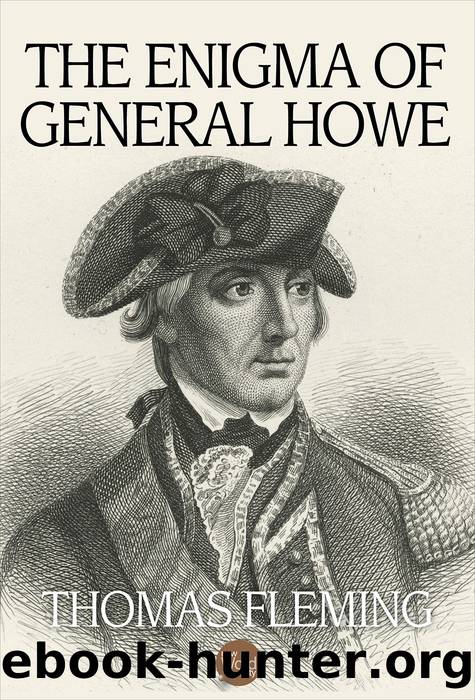
Author:Thomas Fleming [Thomas Fleming]
Language: eng
Format: epub
Tags: History/United States/Revolutionary Period
ISBN: 9781640190207
Publisher: New Word City, Inc.
Published: 2017-11-14T00:00:00+00:00
âI do not now see.â Casually, Howe admits that until Trenton, a âgeneral actionâ was not included in his plan to end the war. Could this rationale explain Washingtonâs repeated escapes from disaster at Long Island, Manhattan, White Plains, and throughout New Jersey?
Washingtonâs victory at Trenton could be attributed to the fortunes of war. But Germainâs refusal to send reinforcements seemed to Howe a low blow, especially since a well-equipped army was handed to General John Burgoyne for a descent from Canada to Albany. Burgoyne had a scheme of his own for ending the war. At Albany he would join with a force under Howe proceeding up the Hudson, and with another from the west under Barry St. Leger. If all went well, New England would be cut off from the rest of the colonies and the two halves of the infant nation could be conquered at will.
From Howeâs point of view, Burgoyne had stolen from him the soldiers he needed for the master plan he had proposed to Germain. Howe wrote to his lordship, telling him that the master plan would now have to be drastically altered. On April 1, 1777, he told Germain, âI propose to invade Pennsylvania by sea.â He admitted this plan meant evacuating the Jerseys and added with irony: âRestricted as I am from entering upon more extensive operations by the want of forces, my hopes of terminating the war this year are vanished.â
Then, on April 5, Howe wrote to Guy Carleton, the British commander in Canada, telling him he had âbut little expectation that I shall be able from the want of sufficient strength in the army to detach a corps in the beginning of the campaign to act up Hudsonâs River.â Meanwhile, Germain wrote Howe approving his plan to invade Pennsylvania by sea. But at the same time, he wrote to Carleton, assuring him he would write to Howe to âguarantee the most speedy junction of the two armies.â Alas for the hopes and dreams of George III, Germain never sent such a letter. All Howe ever got was a copy of Germainâs letter to Carleton, which nowhere contained a specific order limiting Howe to advancing up the Hudson River, and a paragraph in a later letter in which Germain, approving a modification of his Pennsylvania plan, trusted âit will be executed in time for you to co-operate with the army ordered to proceed from Canada.â A major disaster was shaping up: âGentleman Johnnyâ Burgoyne would be fighting his way to Albany to join up with Howe, who instead would be on his way to Philadelphia.
Cooperating with Burgoyne was the one thing Howe had no interest in doing. His defense of his decision to sail to Philadelphia pulsates with resentment in every line: âHad I adopted the plan to go up the Hudson River,â he told the House of Commons, âit would have been alleged that I had wasted the campaign with a considerable army under my command, merely to ensure the progress
Download
This site does not store any files on its server. We only index and link to content provided by other sites. Please contact the content providers to delete copyright contents if any and email us, we'll remove relevant links or contents immediately.
The Vikings: Conquering England, France, and Ireland by Wernick Robert(84381)
Ali Pasha, Lion of Ioannina by Eugenia Russell & Eugenia Russell(40318)
The Conquerors (The Winning of America Series Book 3) by Eckert Allan W(37983)
The Vikings: Discoverers of a New World by Wernick Robert(37006)
Cecilia; Or, Memoirs of an Heiress — Volume 1 by Fanny Burney(32636)
Cecilia; Or, Memoirs of an Heiress — Volume 2 by Fanny Burney(32010)
Cecilia; Or, Memoirs of an Heiress — Volume 3 by Fanny Burney(31996)
Empire of the Sikhs by Patwant Singh(23135)
The Secret History by Donna Tartt(19294)
Hans Sturm: A Soldier's Odyssey on the Eastern Front by Gordon Williamson(18649)
Cat's cradle by Kurt Vonnegut(15441)
Pimp by Iceberg Slim(14666)
Sapiens: A Brief History of Humankind by Yuval Noah Harari(14461)
Norse Mythology by Gaiman Neil(13458)
Talking to Strangers by Malcolm Gladwell(13439)
Leonardo da Vinci by Walter Isaacson(13411)
4 3 2 1: A Novel by Paul Auster(12512)
Underground: A Human History of the Worlds Beneath Our Feet by Will Hunt(12145)
The Radium Girls by Kate Moore(12093)
